
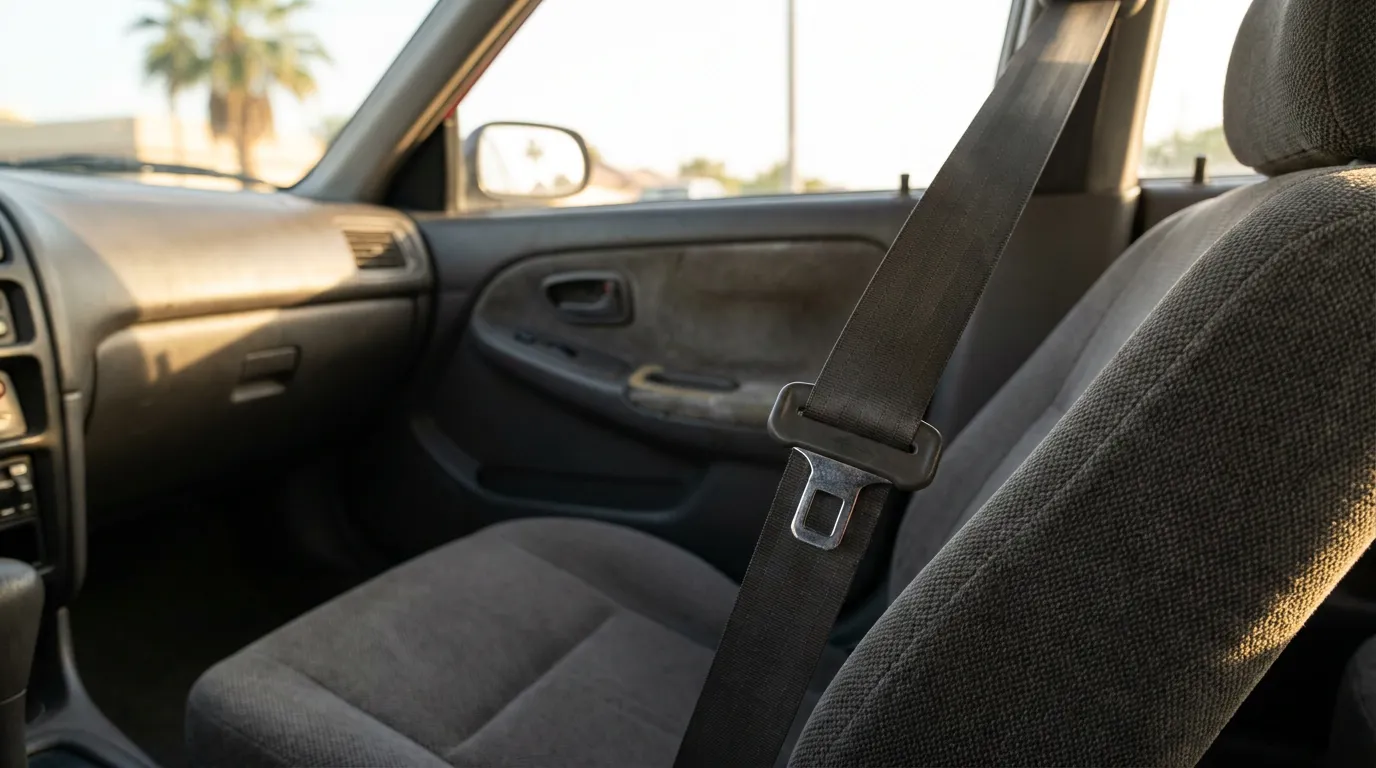
21 Sep What Is the Seat Belt Defense in a Fort Lauderdale Car Accident Case?
When an Insurance Company Blames You for Not Buckling Up
Key Takeaways: The seat belt defense argues that failing to buckle up worsened injuries, potentially reducing damages in a Fort Lauderdale car accident case. It operates through Florida’s comparative fault statute, section 768.81, which proportionally reduces awards and bars recovery entirely for claimants found more than 50 percent at fault. Florida’s Safety Belt Law applies to all drivers, front-seat passengers, and passengers under 18, adult rear-seat occupants generally fall outside the mandate. Defendants must plead comparative negligence as an affirmative defense and prove both nonuse and a causal link between the missing restraint and specific injuries through physical evidence, vehicle data, or expert testimony. Recognized exceptions, including physician-certified medical conditions and certain occupational categories, may defeat the argument when properly documented. Preserving interior photographs, airbag control module data, and accurate medical records early can protect your claim against inflated fault allocations.
The seat belt defense is an argument claiming that an injured person’s failure to wear a seat belt contributed to injury severity, potentially reducing compensation. In Fort Lauderdale car accident cases, this defense doesn’t address crash causation, it targets injury severity and operates through Florida’s comparative fault statute. Understanding how this defense works and where it fails can mean the difference between fair compensation and a drastically reduced settlement.
If an adjuster has asked whether you were wearing your seat belt, treat that as a warning sign. The attorneys at HL Law Group, P.A. understand how insurers build these arguments and how to counter them with evidence and medical proof. Call (954) 713-1212 or contact us now for a free case evaluation with a Broward County car accident lawyer.

The Statutory Foundation Behind the Seat Belt Defense in a Florida Car Accident
Florida’s belt requirement provides legal footing for this defense. Section 316.614, Florida Statutes, the Florida Safety Belt Law, establishes mandatory belt-use duties for covered occupants. Section 316.614(10) provides that failure to wear a safety belt may be considered evidence of comparative negligence in civil actions. Defense lawyers point to this duty when arguing that noncompliance should reduce damages. Florida courts recognized this defense at common law before the statute existed, so nonuse evidence isn’t limited to occupants the mandate covers.
The scope of the duty is crucial. According to the Florida Department of Highway Safety and Motor Vehicles, the state’s safety belt law requirements apply to all drivers, all front-seat passengers, and all passengers under 18 regardless of seating position. Adult rear-seat passengers generally fall outside the mandate, a distinction that can significantly weaken a seat belt defense, though defendants may still argue an available belt should reasonably have been used.
Belt use became a primary offense under the Dori Slosberg and Katie Marchetti Safety Belt Law, effective June 30, 2009, meaning officers may stop and cite drivers for the violation alone. Drivers can be cited when any passenger under 18 is unrestrained. However, a citation is not proof of comparative fault in civil cases.
Florida imposes separate restraint duties for young children. Under section 316.613(1)(a), Florida Statutes, operators transporting children 5 or younger must use crash-tested, federally approved child restraint devices. Defendants may raise restraint nonuse for injured children similarly to belt nonuse for adults, though Florida law generally doesn’t impute a caregiver’s negligence to the injured child.
How Florida Comparative Fault Turns Belt Nonuse Into a Damages Reduction
The seat belt defense operates through Florida’s comparative fault statute. Section 768.81(2), Florida Statutes, provides that contributory fault "diminishes proportionately the amount awarded as economic and noneconomic damages." Juries may assign unbelted occupants a percentage of responsibility for their injuries, reducing awards accordingly.
Under section 768.81(3), Florida Statutes, courts enter judgment based on each party’s percentage of fault. Broward County verdict forms allocate specific percentages, so any fault assigned for seat belt use car accident claim issues directly lowers recovery.
The 51 percent bar significantly raises stakes. Florida’s comparative fault statute reflects 2023 tort reform amendments (chapter 2023-15) applying to causes of action accruing on or after March 24, 2023. Section 768.81(6) bars parties found more than 50 percent at fault from recovering damages entirely, except for medical negligence claims under chapter 766. If insurers stack sufficient comparative fault onto injured occupants, claims may be defeated entirely rather than reduced.
💡 Pro Tip: Never guess about restraint use in recorded statements. If unsure whether your belt was fastened, say so, and let physical evidence, vehicle data, and injury patterns speak.
Insurers use safety statistics to build causation arguments. FLHSMV reports that buckling up reduces the risk of injury or death by almost 50 percent. Defense teams use such figures to argue specific injuries would have been less severe with belts, but general statistics don’t establish what would have happened to a particular occupant in a particular crash.
Who Carries the Burden in a Seat Belt Defense Dispute
The defense must prove their claim. Comparative negligence must be raised as an affirmative defense in pleadings. Under section 768.81(3)(a)1.-2., Florida Statutes, defendants seeking to allocate fault to a nonparty must affirmatively plead that nonparty’s fault and prove it at trial by a preponderance of the evidence. This preponderance standard applies specifically to nonparty fault allocation, not to comparative fault attributed to the claimant.
That burden is often harder than adjusters suggest. Establishing seat belt defense typically requires more than crash report notations, which are generally inadmissible under section 316.066, Florida Statutes. Defendants need physical evidence, biomechanical analysis, or medical testimony connecting restraint absence to specific injuries.
| Issue | What the Defense Must Show | Where Claims Often Fall Apart |
|---|---|---|
| Nonuse | The occupant was actually unrestrained | Belt marks, bruising, or vehicle data contradict the claim |
| Coverage | The occupant was subject to the belt mandate | Adult rear-seat passengers may be outside the statute |
| Causation | Belt use would have reduced the injuries | Injury mechanism unrelated to restraint use |
| Percentage | A specific, supportable fault share | Jurors may reject inflated allocations |
Exemptions and Defenses That Can Defeat the Argument
Florida law recognizes exceptions that may eliminate belt nonuse arguments. FLHSMV identifies several exempted categories. Whether an exception applies is fact-dependent and requires documentation.
Recognized exceptions include:
- Occupants with physician-certified medical conditions making belt use inappropriate
- Employees of newspaper home-delivery services during deliveries
- Buses used to transport persons for compensation
- Farm equipment and certain agricultural vehicles
- School buses manufactured before specified statutory dates
- Trucks with net weight over 26,000 pounds
Documentation is critical. A physician’s certification obtained after the fact may carry less weight than contemporaneous medical records. A Fort Lauderdale car accident attorney can evaluate whether exceptions apply and how to substantiate them.
Practical Steps That Protect an Unbelted Driver Injury Claim
Early evidence preservation often determines leverage. The strongest responses to belt-nonuse arguments are built in the days after a collision, not months later.
- Photograph vehicle interior, including belt webbing, retractors, and load marks
- Request vehicle preservation before repair, salvage, or sale
- Ensure providers document injury patterns accurately
- Obtain crash reports and identify witnesses
- Decline recorded statements to other insurers before consulting counsel
💡 Pro Tip: Airbag control modules record restraint status seconds before impact. This data can be overwritten when vehicles are repaired or sold, so send preservation requests promptly.
Why a Broward County Car Accident Lawyer Changes the Calculation
Insurers raise seat belt defenses because they work when unchallenged. Unrepresented claimants may not know the statutory duty has limits, that exceptions exist, or that Florida’s apportionment rules require actual proof. Adjusters may count on this gap.
HL Law Group, P.A. approaches these disputes as evidentiary problems with legal solutions. Our Fort Lauderdale injury law firm investigates restraint evidence, works with physicians to document injury mechanisms, and challenges inflated fault allocations. A well-documented file can meaningfully affect negotiations.
Frequently Asked Questions
1. Can I still recover damages if I was not wearing a seat belt in a Florida crash?
In many cases, recovery is still possible. Section 768.81(2), Florida Statutes, provides that contributory fault reduces damages proportionately rather than barring recovery. However, under section 768.81(6), claimants found more than 50 percent at fault cannot recover, so allocation size matters greatly.
2. Does the seat belt defense apply to adult back-seat passengers?
Generally, the statutory mandate doesn’t extend that far. Florida’s requirement covers drivers, front-seat passengers, and passengers under 18. Adult rear-seat passengers typically fall outside the mandate, though defendants may still attempt broader common-law arguments.
3. How much can a Florida car crash damages reduction actually be?
There’s no fixed figure. Reduction depends on assigned percentages, which turn on injury mechanism, vehicle evidence, and medical testimony. Some allocations are modest; others may trigger the bar for claimants found more than 50 percent at fault.
4. What if a medical condition prevented me from wearing a belt?
A physician-certified medical condition is among recognized exceptions to Florida’s belt requirement. Whether it applies depends on supporting documentation and certification timing. Contemporaneous medical records generally carry more weight than later statements.
5. Should I admit to an adjuster that I was not buckled?
You’re generally not obligated to give recorded statements to other drivers’ insurers. Your own insurer’s policy may impose cooperation duties, but early statements, often made while injured and medicated, may support comparative fault arguments later. Speaking with counsel first is safer.
Protecting Your Recovery When the Defense Points at Your Seat Belt
The seat belt defense is real but not automatic. It requires defendants to plead and prove nonuse and connect restraint absence to specific injuries. Florida’s modified comparative negligence framework under section 768.81, Florida Statutes, means every percentage point matters, and the bar for claimants found more than 50 percent at fault makes early, well-prepared defense important. Exceptions, evidentiary gaps, and rear-seat coverage limits may provide grounds to fight back.
Don’t let insurers quietly assign undeserved fault. Reach out to HL Law Group, P.A. for a free, no-obligation case evaluation. Call (954) 713-1212 or schedule your consultation today, and let our Fort Lauderdale team handle the insurance company while you focus on healing.
Disclaimer: This content is for informational purposes only and is not legal advice. Every case is unique, and results may vary. Consult an attorney about your specific circumstances.
Sorry, the comment form is closed at this time.