
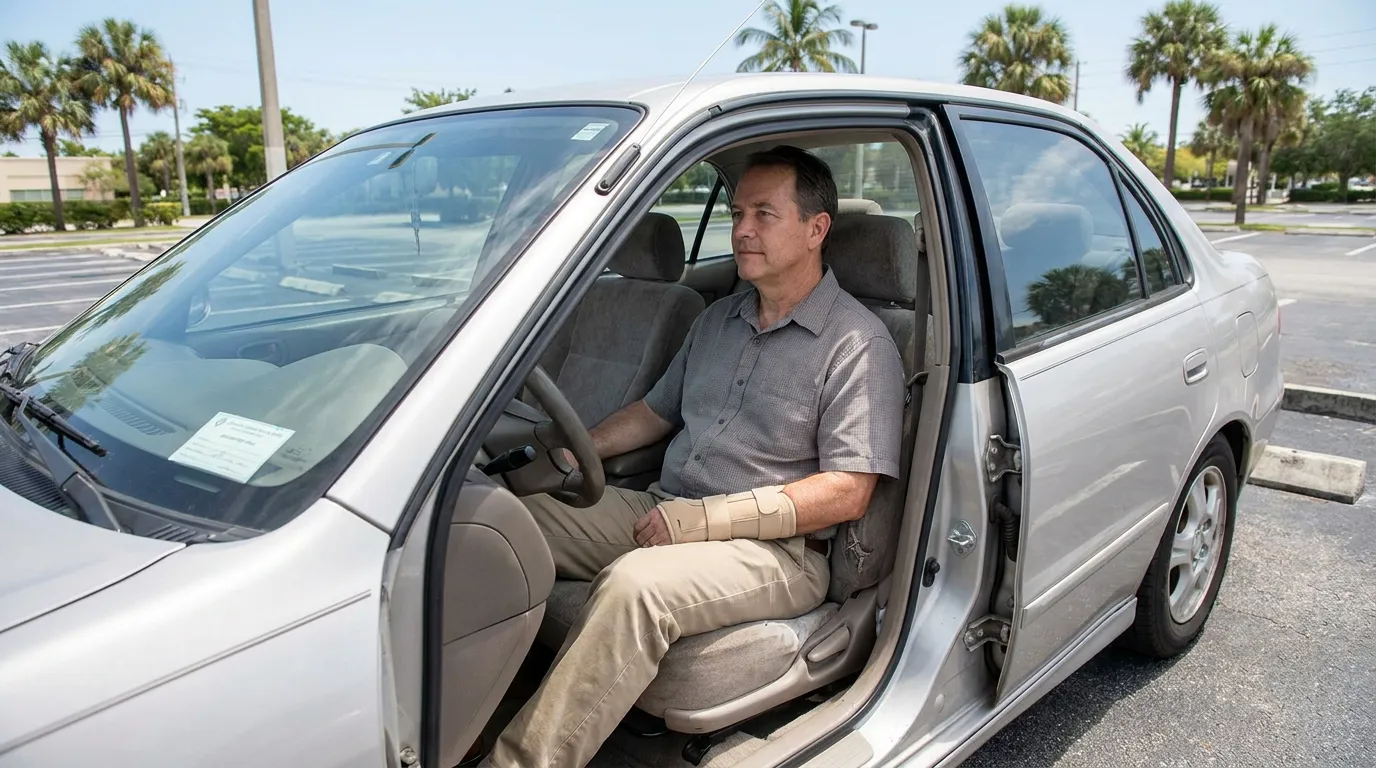
11 Sep What Is Florida’s Permanent Injury Threshold After a Fort Lauderdale Crash?
Why Some Fort Lauderdale Crash Victims Can Sue for Pain and Suffering and Others Cannot
Key Takeaways: Florida’s permanent injury threshold determines whether crash victims can sue for pain and suffering. Under Fla. Stat. § 627.737, non-economic damages are unavailable unless the injury meets one of four categories: significant and permanent loss of an important bodily function, permanent injury within a reasonable degree of medical probability, significant and permanent scarring or disfigurement, or death. Proving permanency requires physician opinion supported by objective findings. Most negligence claims accruing after March 24, 2023 must be filed within two years. Early treatment and documentation matter greatly.
Florida’s permanent injury threshold is the legal gatekeeper that decides whether a crash victim may step outside the no-fault system and pursue non-economic damages. Under Fla. Stat. § 627.737(1), pain, suffering, mental anguish, and inconvenience damages are generally unavailable unless the injury falls within one of four statutory categories in § 627.737(2)(a)-(d). The threshold applies to injuries arising from motor vehicle ownership, maintenance, operation, or use as defined in the No-Fault Law, which excludes motorcycles. Whether your injury qualifies turns on your medical documentation, treating physicians’ opinions, and how well the record is built from the earliest days after the collision.
If you were hurt in a Broward County collision and an adjuster is telling you your injury "doesn’t qualify," it may be worth seeking a careful review before you accept that answer. The team at HL Law Group, P.A. helps injured people across Fort Lauderdale evaluate whether their injuries may satisfy the tort threshold and what evidence may be needed. Call (954) 713-1212 or schedule your free consultation to discuss your situation with a Fort Lauderdale car accident attorney.
How Florida’s No-Fault System Created the Need for a Threshold
Florida is a no-fault state, and that single fact shapes nearly every car accident claim in Broward County. The Florida Department of Highway Safety and Motor Vehicles explains that registering a four-wheel vehicle generally requires Personal Injury Protection and Property Damage Liability coverage. Florida insurance requirements include a minimum of $10,000 in PIP and $10,000 in PDL.
PIP pays a portion of your losses regardless of fault. According to FLHSMV, PIP "covers 80 percent of all necessary and reasonable medical expenses up to $10,000," which also includes disability benefits (generally 60 percent of lost income) and death benefits. Initial services must be received within 14 days of the crash. Benefits are limited to $2,500 unless a qualifying provider determines the injured person had an emergency medical condition. For a sprain that resolves in six weeks, that may be enough. For a herniated disc requiring injections or a fracture requiring hardware, it rarely is.
Because PIP pays regardless of fault, fault alone does not open the courthouse door for non-economic damages. The threshold generally does.
The Four Categories Under the Florida Permanent Injury Threshold Car Accident Rule
Fla. Stat. § 627.737(2) lists four categories, and a plaintiff generally must fall into at least one to recover pain and suffering damages. Suit for non-economic damages is generally barred unless the injury meets one of these definitions:
- Significant and permanent loss of an important bodily function
- Permanent injury within a reasonable degree of medical probability, other than scarring or disfigurement
- Significant and permanent scarring or disfigurement
- Death
Each category carries its own proof challenges. "Significant" and "permanent" are not defined with mathematical precision, which means courts and juries consider the full medical picture, including imaging, objective clinical findings, treatment history, and credible physician testimony.
What "Permanent Within a Reasonable Degree of Medical Probability" Usually Requires
This category is the one most often litigated in Broward County crash cases. It generally requires a treating or examining physician to state, to a reasonable degree of medical probability, that the injury will not fully resolve. A note saying you "may have ongoing pain" is typically weaker than a clear permanency opinion supported by objective findings such as MRI results, positive orthopedic testing, or documented neurological deficits.
Insurers frequently retain examining physicians who may reach the opposite conclusion. That disagreement does not necessarily end your claim, but it means permanency may become a battle of medical opinions. Where evidence conflicts, permanency is generally a jury question, though a court may decide it when the evidence is essentially undisputed.
Why Gaps in Treatment Can Undermine a Threshold Argument
Treatment gaps are one of the most common reasons a strong claim becomes difficult. When victims stop treating for several weeks and then resume, defense counsel often argues the injury either resolved or was caused by something else. A gap is not automatically fatal and can be explained by cost, insurance limits, or work obligations, but consistent, documented care from the outset generally builds a far more persuasive record.
💡 Pro Tip: Tell every provider about every symptom at every visit, including symptoms that seem minor. Complaints that never appear in the chart are difficult to prove later.
The Threshold Also Applies to Uninsured Motorist Claims
Meeting the threshold may matter even when the at-fault driver has no liability coverage. Under Fla. Stat. § 627.727(7), uninsured motorist coverage does not include tort damages for pain, suffering, mental anguish, and inconvenience unless the injury meets one or more of the § 627.737(2) categories. Your own UM carrier may raise the same threshold defense an at-fault driver’s insurer would.
This surprises many people who assume UM coverage functions differently. It generally does not, at least on the non-economic damages question. Readers who want a plain-language walkthrough may find our discussion of Florida’s serious injury threshold helpful.
What Happens When the Defense Challenges the Threshold
Florida law gives defendants a specific procedural tool to test threshold evidence before trial. Fla. Stat. § 627.737(3) provides that when a defendant contests whether the plaintiff met the threshold, the defendant may file an appropriate motion, and the court shall, on a one-time basis only, 30 days before the date set for the trial or the pretrial hearing (whichever is first), examine the pleadings and evidence before it to ascertain whether the plaintiff will be able to submit some evidence of meeting subsection (2). If the court finds the plaintiff will not be able to submit such evidence, the claim shall be dismissed without prejudice.
Dismissal without prejudice is not necessarily the end, because the claim may be refiled if the limitations period has not run, but it can be a serious setback given Florida’s shortened filing deadline. This is one reason experienced counsel typically works to develop permanency evidence early.
| Damage Type | Available Without Meeting Threshold? |
|---|---|
| Medical expenses through PIP | Generally yes, subject to policy limits |
| Lost wages through PIP | Generally yes, subject to policy limits |
| Property damage | Generally yes, through PDL or liability coverage |
| Pain, suffering, mental anguish, inconvenience | Generally no, unless Fla. Stat. § 627.737(2)(a)-(d) is satisfied |
The Two-Year Deadline That Now Governs Most Broward County Crash Claims
Meeting the threshold may accomplish little if a filing deadline is missed. Under Fla. Stat. § 95.11, as amended by 2023 HB 837, negligence actions accruing on or after March 24, 2023 are generally subject to a two-year limitations period rather than the prior four years. That change cut the available window in half for most Fort Lauderdale crash victims.
Limited exceptions and tolling doctrines exist, such as those for minors, but Florida courts generally interpret them narrowly. Wrongful death claims are governed by a separate two-year period under Fla. Stat. § 95.11(5), and claims against governmental entities follow different notice rules under Fla. Stat. § 768.28.
💡 Pro Tip: Calendar your deadline from the crash date and treat it as firm. Waiting to see whether an injury becomes "permanent enough" can quietly consume the entire filing window.
Why the Threshold Drives So Much Broward County Litigation
Auto-injury claims have long dominated Florida personal injury litigation. Fort Lauderdale’s dense corridors along I-95, US-1, and Broward Boulevard generate a high volume of collisions, and the threshold is often the central contested issue.
Practical steps that may strengthen a threshold position include seeking prompt medical evaluation, following prescribed treatment, preserving crash scene photographs and the traffic crash report, identifying witnesses early, and documenting how the injury changed daily activities. None of these guarantee any particular outcome, but each generally improves the evidentiary record. Our Fort Lauderdale car accident attorney team handles these issues throughout South Florida.
Frequently Asked Questions
1. Does the Florida permanent injury threshold apply to every car accident claim?
The threshold generally governs claims for pain, suffering, mental anguish, and inconvenience involving motor vehicles covered by the No-Fault Law. It does not typically bar recovery of medical expenses, lost earnings, or property damage, and generally does not apply to motorcycles.
2. Who decides whether my injury is permanent?
Medical evidence drives the analysis, and a physician’s permanency opinion within a reasonable degree of medical probability is usually central. If parties present conflicting evidence, the question is generally resolved by a jury, though a court may decide it when evidence is undisputed.
3. Can soft tissue injuries meet the serious injury threshold in Florida?
Sometimes, though these claims are frequently contested. Objective evidence such as imaging showing a herniation or documented permanent range-of-motion loss generally strengthens the argument. Results depend entirely on the individual medical record.
4. What if I already exhausted my PIP benefits?
Exhausting the $10,000 PIP limit does not by itself satisfy the tort threshold. You still generally must show your injury fits one of the four statutory categories before pursuing non-economic damages, although economic damages exceeding PIP may be recoverable from an at-fault party.
5. How long do I have to file after a Fort Lauderdale crash?
For negligence claims accruing on or after March 24, 2023, the general limitations period is two years. Certain circumstances may alter that analysis, and claims against government entities follow different notice rules. Prompt legal review is the safest approach.
Protecting Your Claim Before the Threshold Question Becomes a Problem
Florida’s tort threshold is not a technicality. It can be the difference between recovering only limited PIP benefits and pursuing meaningful compensation for the pain, limitations, and life changes a serious crash causes. Because Fla. Stat. § 627.737(2) generally requires proof of death, permanency, or significant scarring, and because Fla. Stat. § 95.11 now imposes a two-year window in most negligence cases, the decisions you make in the first weeks after a collision may shape the entire case.
If you or a loved one suffered injuries in a Fort Lauderdale or Broward County collision, get answers before the deadline narrows your options. HL Law Group, P.A. offers free case evaluations to injured people across South Florida and is trusted by clients for its dedication to results. Call (954) 713-1212 or request your free case review today.
Disclaimer: This content is for informational purposes only and is not legal advice. Every case is unique, and results may vary. Consult an attorney about your specific circumstances.
Sorry, the comment form is closed at this time.