

04 Oct Why Uber’s $50,000 Period 1 Limit Falls Short for Broward Crash Victims
The Rideshare Insurance Trap Waiting Behind Every Broward Pickup
Key Takeaways: Florida’s rideshare statute, Fla. Stat. § 627.748, splits Uber driving into coverage periods that dramatically affect claim value. Period 1 (logged on without an accepted ride) requires only $50,000 per person in bodily injury coverage, while an accepted ride triggers at least $1 million combined. That $50,000 floor rarely covers serious Broward crashes involving hospitalization, surgery, lost wages, and long-term care. The gap widens because Florida permits personal auto insurers to exclude coverage while drivers are logged on. Other sources may include PIP, uninsured or underinsured motorist coverage, household policies, and claims against additional at-fault drivers. The company’s coverage must apply from the first dollar when the driver’s policy lapses or does not provide required coverage. Because app timestamps, dashcam footage, and witness memory fade quickly, and negligence claims accruing on or after March 24, 2023 carry a two-year deadline, early investigation is critical.
When an Uber driver strikes you on Federal Highway or Sunrise Boulevard, your claim value may hinge on something invisible: whether that driver had accepted a ride request. Under Florida’s transportation network company statute, a driver logged on without an accepted ride carries only $50,000 in bodily injury coverage per person. That single fact can separate full recovery from devastating shortfall, which is why understanding uber accident insurance coverage periods florida drivers operate under matters after a Broward County crash.
If you were injured by a rideshare driver anywhere in South Florida, the coverage period question deserves immediate attention. The team at HL Law Group, P.A. helps injured people in Fort Lauderdale and throughout Broward County identify available policies before deadlines and evidence slip away. Call (954) 713-1212 or contact us now for a free case evaluation.
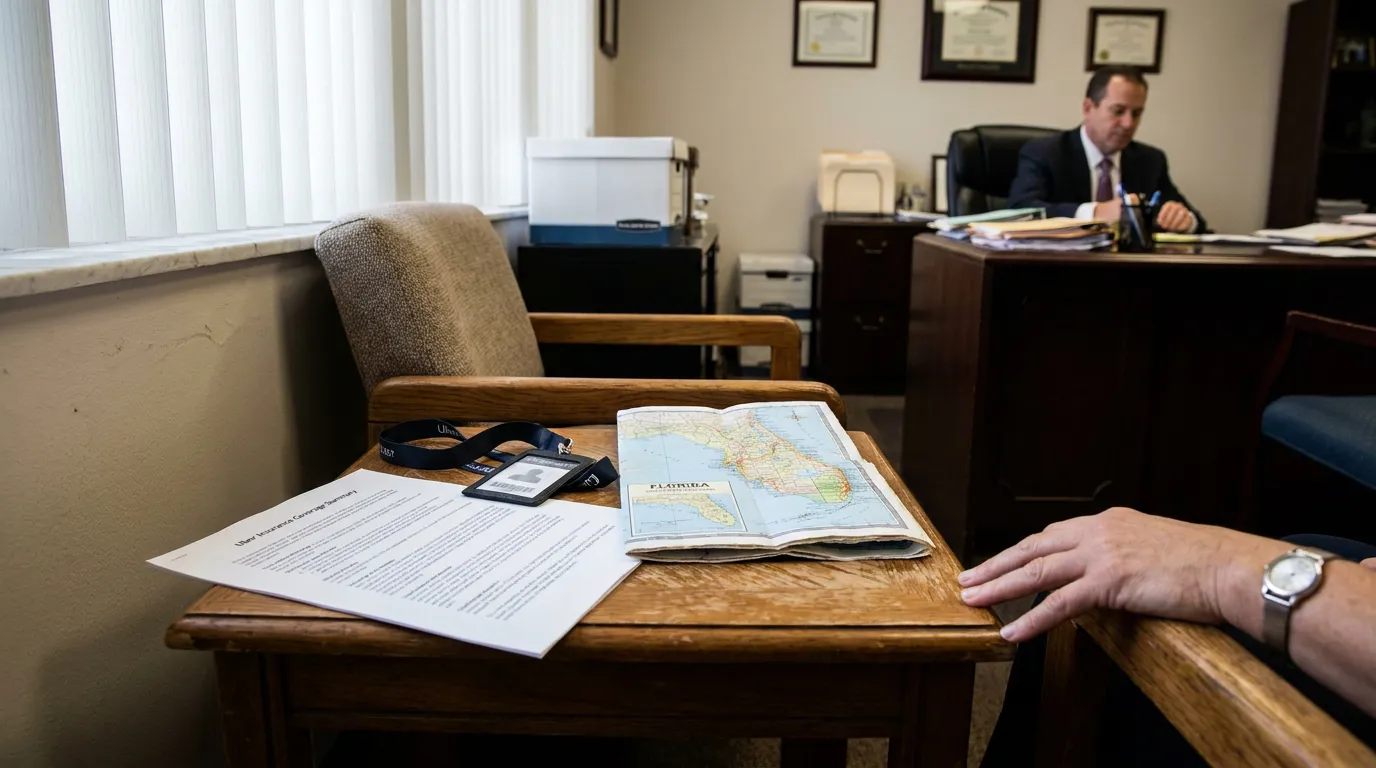
How Florida Divides Rideshare Coverage Into Periods
Florida law does not treat rideshare driving as a single activity with one insurance policy. Instead, Fla. Stat. § 627.748 breaks driving into distinct phases, each carrying different minimum coverage obligations. The dividing lines are statutory and frequently among the first things defense adjusters investigate.
The most consequential line is the statutory definition of a "prearranged ride." Under Fla. Stat. § 627.748(1), a prearranged ride begins when the driver accepts a ride requested through the digital network, not when the passenger enters the car, and ends when the last rider exits. A driver en route to a Victoria Park pickup may already be in the higher-coverage tier, even with an empty back seat.
Period 1: Logged On and Waiting
Period 1 describes the driver who has the app open but has not accepted a request. Fla. Stat. § 627.748(7)(b) requires primary automobile liability coverage of at least $50,000 for death and bodily injury per person, $100,000 per incident, and $25,000 for property damage during this window. Those are statutory minimums; a driver or company may carry more. For serious crash victims, that figure can be exhausted quickly.
Periods 2 and 3: Accepted Rides and Occupied Vehicles
Once the driver accepts a request, required liability coverage rises to at least $1 million. Fla. Stat. § 627.748(7)(c) requires primary automobile liability coverage of at least $1 million for death, bodily injury, and property damage during a prearranged ride, along with PIP benefits meeting limousine requirements under Fla. Stat. §§ 627.730-627.7405 and uninsured and underinsured vehicle coverage as required by Fla. Stat. § 627.727. Identical injuries, identical intersection, potentially very different insurance.
| Coverage Period | Driver Status | Minimum Liability Required |
|---|---|---|
| Period 1 | Logged on, no ride accepted | $50,000 per person / $100,000 per incident / $25,000 property |
| Periods 2-3 | Ride accepted through vehicle exit | At least $1 million combined |
Why the Uber $50,000 Limit Falls Short in Serious Broward Crashes
The Period 1 minimum was written as a floor, not a realistic measure of harm. A single ICU admission at Broward Health Medical Center, followed by orthopedic surgery and rehabilitation, can consume $50,000 before a victim leaves inpatient care. Add lost wages, future treatment, and non-economic damages, and the gap becomes significant.
Catastrophic injuries widen that gap dramatically. Victims who sustain a traumatic brain injury may face cognitive therapy, vocational retraining, and lifetime supportive care. Low policy limits do not shrink those needs; they simply shift the burden onto injured families unless other coverage sources are located.
💡 Pro Tip: Photograph the driver’s app screen at the scene if it is safe and lawful to do so. App status is often disputed later, and contemporaneous evidence can be difficult to reconstruct.
The Personal Policy Exclusion That Creates the Rideshare Coverage Gap
Many Broward victims assume the driver’s own auto policy provides a backstop, but Florida law may permit the opposite. Under Fla. Stat. § 627.748(8), a personal automobile insurer may exclude coverage, including liability, uninsured and underinsured motorist, medical payments, comprehensive, collision, and personal injury protection, while the driver is logged on to the digital network or engaged in a prearranged ride. Whether an exclusion applies depends on the particular policy wording. Some drivers purchase rideshare endorsements that fill part of the gap. Where the exclusion applies, it creates the rideshare coverage gap Broward families encounter after Period 1 collisions.
The statute also supplies a valuable investigative tool. In a claims coverage investigation, a transportation network company must immediately provide, upon request by a directly involved party or insurer, the precise times the driver logged on and off the network in the 12-hour periods immediately before and after the accident. Those timestamps often resolve the coverage-period dispute that determines whether $50,000 or $1 million applies.
Additional Coverage Sources Beyond the Liability Limit
Period 1 is not liability-only, which is why careful policy searches matter. Fla. Stat. § 627.748(7)(b) also requires PIP benefits under Fla. Stat. §§ 627.730-627.7405 and uninsured and underinsured vehicle coverage as required by Fla. Stat. § 627.727. These requirements may be satisfied by the driver’s insurance, the company’s insurance, or a combination.
Practical recovery avenues that may exist alongside the low liability limit include:
- Your own uninsured or underinsured motorist coverage, subject to policy terms and stacking provisions
- Personal injury protection benefits, which are capped and frequently insufficient alone
- Household relative UM policies, where applicable
- Claims against additional at-fault drivers whose negligence contributed
Because PIP alone rarely covers serious injuries, it may help to understand Florida’s $10,000 PIP cap and how it interacts with rideshare coverage.
Pushing Back When an Insurer Says No Coverage Exists
Being told the driver was uninsured is not necessarily the end of the analysis. Fla. Stat. § 627.748(7) provides that if the driver’s policy has lapsed or does not provide required coverage, the insurance maintained by the transportation network company must provide coverage beginning with the first dollar of a claim, together with a duty to defend. That obligation is statutory, though application depends on facts and the established coverage period.
Delay tactics may also have a statutory answer. Fla. Stat. § 627.748(7) states that required coverage need not be dependent on a personal automobile insurer first denying a claim. In some cases, citing this provision directly may help move stalled files forward.
💡 Pro Tip: Request the trip record and app log in writing early. Verbal assurances from an adjuster about app status generally carry little weight in litigation.
The Deadline That Can Quietly End a Broward Uber Claim
Florida gives negligence claimants a limited window, and rideshare cases are no exception. Under Fla. Stat. § 95.11(5)(a), as amended by HB 837, a negligence action must be commenced within two years for causes of action accruing on or after March 24, 2023; claims that accrued before that date are governed by the prior four-year period. Related claims run on different clocks, including wrongful death, which generally must be brought within two years of death. You can review the governing Florida limitations statutes to see how the provision is organized.
Exceptions such as tolling or claims involving minors exist in limited circumstances, and Florida courts construe them narrowly. No claimant should assume an extension will apply. Administrative or internal claim procedures maintained by a rideshare company do not extend statutory deadlines.
Why Early Investigation Protects Leverage
Coverage-period evidence degrades quickly. Dashcam footage from businesses along Las Olas or Commercial Boulevard is often overwritten within weeks, and witness recollection fades. A Fort Lauderdale Uber accident lawyer can issue preservation requests and pursue app data while it still exists.
Frequently Asked Questions
1. How do I find out which uber accident insurance coverage periods Florida law applied to my crash?
The determination rests on documented app status at impact. Fla. Stat. § 627.748 allows a claims coverage investigation to obtain precise log-on and log-off times within the 12 hours before and after the accident, which often resolves the question.
2. Does the $1 million policy apply if the driver had no passenger yet?
It may. Fla. Stat. § 627.748(1) defines a prearranged ride as beginning when the driver accepts the request, so a driver traveling to a pickup is generally within the higher-coverage phase, subject to specific facts and proof of app status.
3. What if my damages exceed the Period 1 minimums?
Additional sources may be available, including your own uninsured or underinsured motorist coverage under Fla. Stat. § 627.727 and claims against other negligent parties. Whether recovery beyond the liability limit is possible depends on the policies involved and evidence of fault.
4. Can Uber refuse to pay because the driver had personal insurance?
Under Fla. Stat. § 627.748(7), required coverage must not be dependent on a personal automobile insurer first denying a claim. Disputes still arise, and outcomes depend on the coverage period involved and how the claim is documented.
5. How long do I have to file a Broward rideshare injury lawsuit?
Fla. Stat. § 95.11(5)(a) sets a two-year deadline for negligence actions accruing on or after March 24, 2023, and other deadlines may apply to different claims. Because narrow exceptions are applied restrictively, acting well before the deadline is prudent.
Protecting Your Recovery When the Numbers Do Not Add Up
The difference between $50,000 and $1 million in a Broward Uber crash may come down to a timestamp. Florida’s tiered structure under Fla. Stat. § 627.748 can benefit claimants who investigate app status early, identify applicable policies, and understand that insufficient Uber insurance in Period 1 does not necessarily mean insufficient total recovery.
If a rideshare driver injured you or someone you love in Fort Lauderdale, do not accept a low limits explanation at face value. HL Law Group, P.A. offers free, confidential case evaluations to Broward County crash victims. Reach the firm at (954) 713-1212 or request your consultation today to discuss your options.
Disclaimer: This content is for informational purposes only and is not legal advice. Every case is unique, and results may vary. Consult an attorney about your specific circumstances.
Sorry, the comment form is closed at this time.